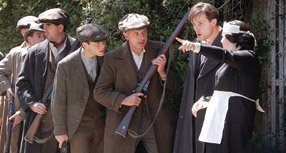
The Wind That Shakes the Barley (Ken Loach) 65 - Ken Loach’s The Wind That Shakes the Barley turned some heads this year when it was announced as the surprise winner of the Palm D’Or at Cannes, but for its riveting first seventy minutes, it’s likely that viewers will wonder why there was any fuss at all in choosing to award the film. Set in 1920’s Ireland, Loach’s latest work starts strongly. It begins by establishing an idyllic backdrop and almost immediately smashes it with the arrival of a group of extraordinarily aggressive British troops. After an unjust murder is committed, Damien (Cillian Murphy), a doctor who was about to leave for London, commits himself instead to the Irish Republican Army’s attempts to drive the British from their country. From that point on, the film launches a series of impressively taut set pieces that detail the terrorist attacks and countermeasures that the soldiers execute. Throughout the first half, by stressing the Army’s covert operations, Loach generates tension in nearly every scene, resulting in a film that seems to merit comparisons to great political nailbiters like Melville’ss Army of Shadows and Rohmer’s The Lady and the Duke. Two or three scenes manage a forceful, punch-in-the-gut quality that wholly crystallizes the clear-minded sense of purpose that Loach strives for throughout. It’s to the film’s credit that Loach directs with such righteousness that it’s almost impossible to keep in mind during the film’s first half that the events that are dramatized took place eighty-five years ago.
After the midway point, however, Loach begins to lose his masterful grip over the film. When the possibility of conditional peace with the British divides the Irish rebels, Barley settles into a series of scenes in which characters take turns speechifying, ensuring that each point of view among the rebels becomes abundantly clear. Though the film never completely runs out of steam, Loach fails to hit the grace notes that he seemed to effortlessly achieve earlier on. Starting with a scene in which a woman is forcibly shorn by British troops, Loach actively courts outrage from the audience, instead of merely conveying a sense of anxiety. The result is dull in comparison, no matter how politically justified it might be. There’s hardly a single significant British character in the film, but that scarcely matters. It’s obvious from the start that Loach is not trying to be fair-minded here. What is more problematic than the treatment of the Brits is the film’s development of its Irish contingent. The majority of characters are obvious political mouthpieces, which is acceptable, if not ideal, since it’s likely that in tumultuous times politically committed people push their personal lives aside. More troubling, however, is the script’s melodramatic attempt to stir up drama when two Irish brothers are put at odds with one another. This creaky old device oversimplifies the internal conflict of the IRA and generates little emotional involvement to boot.